
How Does an Auger Filler Work?
An auger filler doses powder by turning a screw (the auger) inside a tube for a set number of revolutions; each turn pushes out roughly the same volume of powder. A servo or stepper motor controls the turns precisely, an agitator keeps the powder in the hopper moving, and the result is ≤±0.5% accuracy for 1–1000 g fills on our semi-automatic fillers when the powder is consistent.
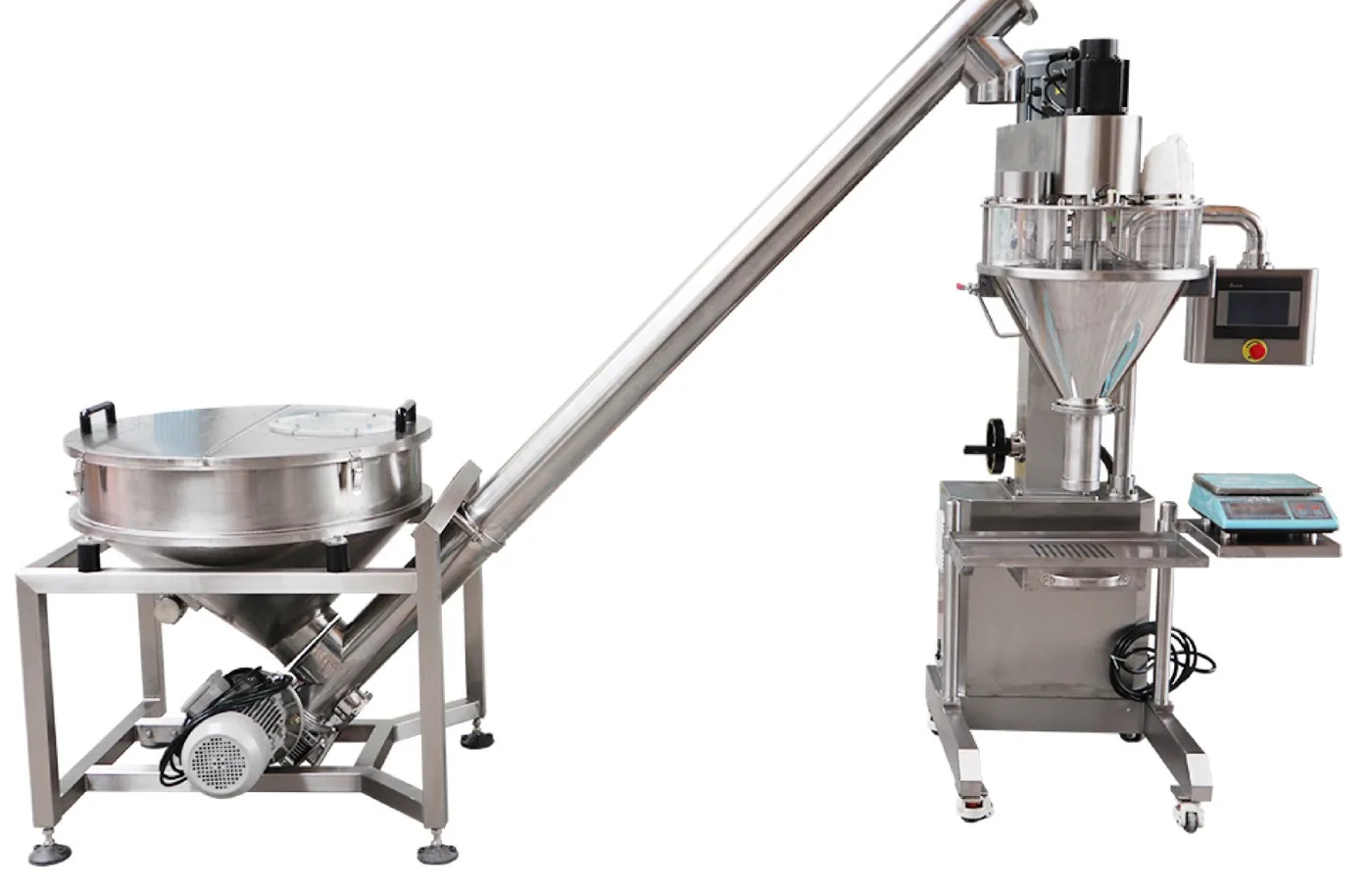
What are the parts of an auger filler?
- Hopper (15 L tabletop, or 30/50/80 L on our semi-automatic fillers)
- Agitator: stirs the powder so it does not bridge or cake
- Auger screw and tube: sized to the fill weight — small augers for grams, large for kilograms
- Servo or stepper motor: counts the turns
- Level sensor and screw conveyor: keep the hopper topped up
- Optional load cell: weighs each fill and corrects the turns
Why do auger fills drift?
Because the auger measures volume, not weight. When powder settles in the hopper, absorbs moisture or changes batch, its bulk density changes and the same number of turns delivers a different weight. Keeping the hopper level constant, using an agitator and adding weight feedback or a check weigher keep fills on target.
Which powders suit an auger filler?
Fine, dusty, non-free-flowing powders that cups and weighers cannot handle: milk powder, flour, coffee, cocoa, spice, protein, detergent, chemical powders. Free-flowing granules such as sugar or rice are cheaper to dose with cups or a weigher.
How do I choose the auger size and hopper?
| Fill weight | Our recommendation |
|---|---|
| 1–200 g, small batches | 15 L tabletop auger filler |
| 1–1000 g, jars or bags | 30 L semi-automatic filler (≤±0.5%) |
| 100 g – 5 kg | 50 L semi-automatic filler |
| 5–20 kg | 80 L filler (±1%) |
| 10–25 kg sacks | Dual-speed auger bag filler with load cell |
How do I stop dust at the nozzle?
Fit a dust collector at the outlet, keep the nozzle inside the container with a holder, and use anti-drip tooling so powder does not trickle between fills.
Frequently asked questions
Servo or stepper motor?
Both count turns precisely. Servo motors respond faster and hold accuracy at higher speeds; stepper motors cost less and are fine for small tabletop fillers.